Only the champions might be happy with Minnesota’s student-athlete transfer system
Inside an imperfect system: Because the high school league is “not an investigative body,” athletic directors own the burden of enforcing Minnesota’s trust-based transfer setup. Coaches are often caught in the middle, too.

By Marcus Fuller and Joe Christensen
The Minnesota Star Tribune
TRANSFERRING IN MINNESOTA | This is part of an exclusive Strib Varsity series.
. . .
When Minnehaha Academy secured its Class 2A boys basketball state title in March, it was in large part thanks to a standout junior guard who had arrived at the school seven months earlier from Breck.
Another former Breck guard helped lead his new school, Totino-Grace, to a Class 3A title a couple of hours earlier that day at Williams Arena.
And in that night’s Class 4A big-school showdown, the all-around play of a relative newcomer was a highlight of Chaska’s first state title in 22 years. “We don’t win without him,” Hawks coach Nick Hayes said of his hustling sophomore forward.
Transfer students make up just 1% of Minnesota’s high school athletes, but their impact on top teams is far greater — and increasingly visible on championship stages.
Their movement between schools is reshaping competition and fueling a growing debate over fairness and oversight.
The leaders involved — with the Minnesota State High School League, the coaches, the athletic directors and parents, too — are increasingly worried that high school sports are becoming more like college sports, where team rosters now turn over year after year as athletes chase dollars and trophies. But unlike the college system, Minnesota’s high school transfer rules are built largely on trust.
That trust-based system, some say, is being abused.
More than a dozen coaches and athletic directors told Strib Varsity that the system in particular needs modernizing because “people are able to beat it,” said one coach. Or, as an athletic director said, “People are always looking, like anything in life, for that loophole.”
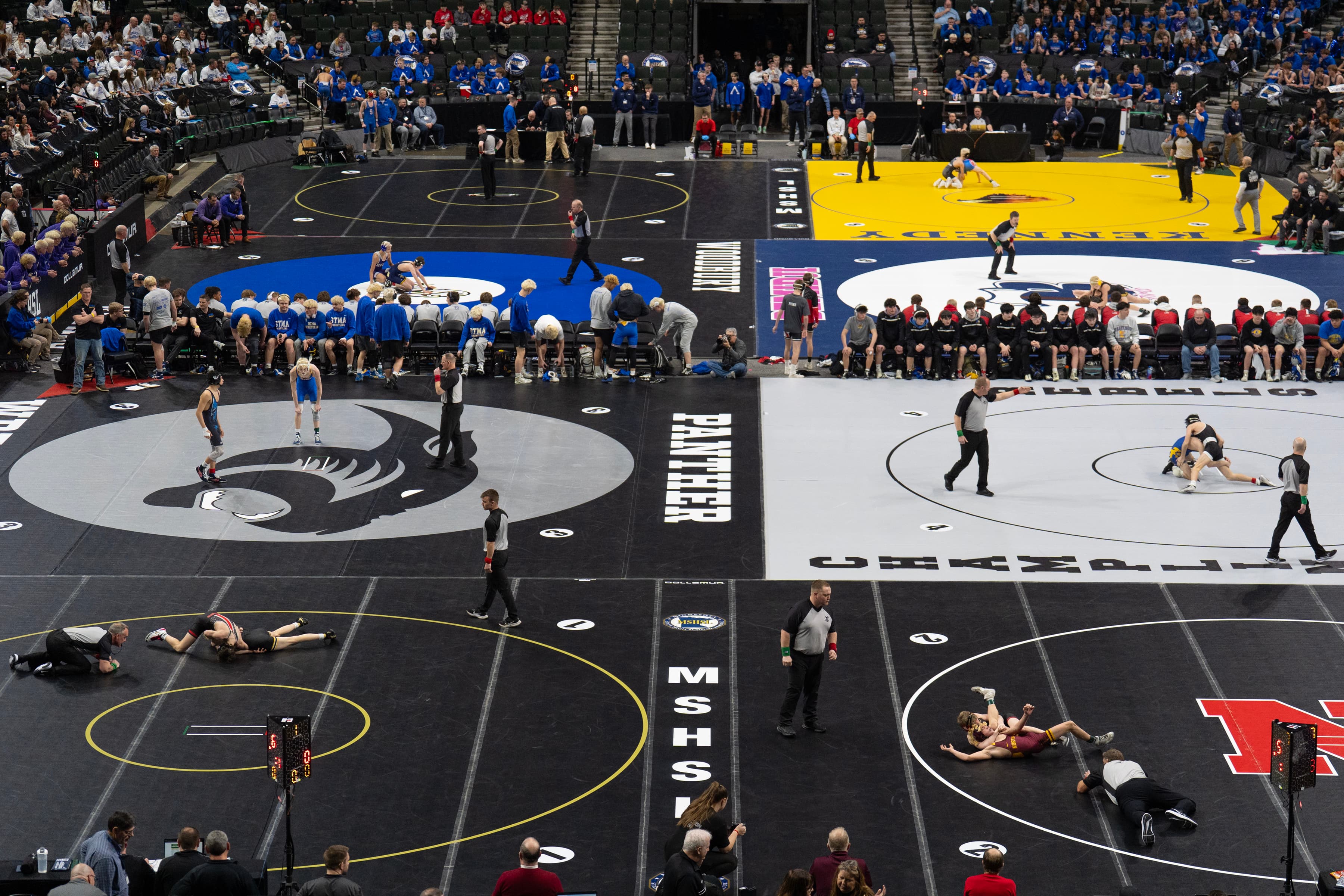
Transfers not only take center stage on Championship Saturday for boys and girls basketball, but also during the wrestling state tournament, in high-stakes volleyball matches, at football’s Prep Bowl, in front of sold-out hockey crowds and more.
A Strib Varsity review of top teams found nine of the Top 25 boys basketball teams in the state began the year with a key contributor who transferred in during high school. In girls basketball, eight of the top 12 teams had the same, including the entire top five. Seven of the 12 hockey and basketball teams that won boys or girls state titles this winter had a transfer student playing a key role.
Over the next two weeks, Strib Varsity will publish a series of articles that dive into the debate over high school transferring. Readers will hear from the athletes themselves, get a detailed breakdown of the process, go inside the decision-making with Minnesota families and more.
And while the impact transfer athletes have on competition swells by the school year, the number of transfers remains relatively consistent — and relatively small. In the past decade, the number of student-athletes requesting a transfer has fluctuated between 1,150 and just under 2,400. There are roughly 230,000 total student-athletes in the state.
Most often, athletes can continue playing varsity sports when they switch high schools because their family moved. Moving is the most common of explanations in Minnesota’s high school athlete transfer portal. Other explanations that enable eligibility retention include transferring to leave a harassment situation or to benefit a student with a diagnosed mental health disorder.
To work fairly, this system requires parents and ADs to submit the truth about a student’s address or well-being. The MSHSL is not doing bed checks or psychological evals for hundreds of students across the state.
“We are not an investigative body,” said Bob Madison, the MSHSL senior associate director who oversees athlete eligibility. He sees his mission as making sure athletic directors and families understand the multilayered policy. “Our transfer portal is a management system for our schools to talk to each other to ensure the transfer is happening correctly.”
A transferring student-athlete without an eligibility-extending explanation sits out for 12 months. It’s much more common to see a student-athlete wearing a new uniform than it is to see one sitting on the bench waiting out the calendar year.
“There are those who try to figure out what can work with what they would want relative to what those rules are,” MSHSL executive director Erich Martens said. “That’s a natural desire for our families. We understand that.”
Pressure on ADs
Several coaches told Strib Varsity that they want to see more regulation on transfers by the high school league, even though “they’re not an investigative agency,” said Tom Critchley, the executive director of the Minnesota Basketball Coaches Association.
“The high school league basically leaves it up to the discretion of the athletic directors,” he added.
The MSHSL enforces a policy that has detailed rules and is available to all in an online guide. The policy includes as many as three different appeals processes for transfer athletes denied eligibility. The league has biweekly hearings, and every year it declares several students ineligible for varsity competition at their new schools. (These students can return to their former schools or play at the junior varsity level for a year.)
But ineligibility doesn’t happen often. People find ways to make the rules work for them, Maranatha Christian Academy boys basketball coach Al Harris said.
“The way the rule is right now, people are able to beat it,” Harris said. “[By using] mental health [as a reason to transfer], you can get it right away. You can’t even dispute it.”
When a transfer request is submitted, the pressure is on the “receiving” athletic director, the AD at the school a student wants to attend, to verify submitted information and navigate the policy.
“There’s no doubt that the [athletic director receiving a transfer] is making the determination, is spending time with the family, talking about what is happening,” Edina AD Troy Stein said. “They’re submitting their information to the sending school, confirming it. Then the high school league essentially looks at that information and confirms it as well or says we need more information.”
There are complicated cases every year in the state. A student can appeal to the MSHSL’s Eligibility Committee and present their case in person for up to 15 minutes.
“That can be a very difficult 15 minutes for the family, but sometimes it gives them the opportunity to tell us what they haven’t been able to tell us yet,” Madison said. “Either their financial standing or a gut-wrenching health [situation] that they aren’t willing to share.”
With the pressure of being the primary arbiter of transfer cases, athletic directors like Gary Revenig of Monticello are constantly analyzing how they’re handling transfers.
“People are always looking, like anything in life, for that loophole,” he said. “How can they find a way to get around the rules? And it’s something we keep reevaluating. What do we need to do? What do we need to tighten up on?”
Yet there’s only so much an AD can do to verify information, said longtime Tartan boys basketball coach Mark Klingsporn.
“If the kid gives you an address, then that’s his address. Athletic directors have told me that,” said Klingsporn, who coached more transfers this past season (four) than he had the previous six seasons combined. “Unless there’s an appeal or something, [the MSHSL] doesn’t get involved at all. ... They have a failsafe because it’s up to the athletic directors. ‘It’s not up to us. We put it in the hands of the athletic directors.’
“I would say that if a kid is sitting out right after not moving, then they didn’t know how to cheat. They didn’t know how to beat the system.”
MSHSL leaders hear the criticisms, of course. Madison isn’t sure investigations and punishments will lead to harmony.
“‘Let’s make fines bigger. Let’s make the hammer bigger,’” he said. “And that will solve it? I’m not sure it will.”
Critchley, the association director, wants to see coaches take on more of the rules enforcement, too. If a coach knows an athlete is using “someone else’s address,” then the coach needs “to go to your AD and tell them that,” he said. “And your AD should be investigating that.
“If a family gives an address, and the rule is you ‘your head needs to be lying there every night,’ and if [the coach] knows that’s not true, why don’t they report it?”
When a transfer athlete arrives on a team, they might be taking the roster spot of a student who has been in the program for years. Those situations are “tough ones” for Andover AD Eric Lehtola. In every situation, though, he said athletic directors are doing their best to navigate a complicated, imperfect process.
“We’re honest and hardworking, and we’re put in a tough situation to filter through every vignette that’s thrown our way, and everybody else knows more about the truth than we do. And we are presented with what people want to present us with,” he said. “So, you know, it’s tough.”
And it’s unlikely to get any easier. Once a fringe topic, transferring is now here to stay as part of the fabric of Minnesota high school sports. The two constants will be spirited debates and policy modifications.
Madison said the league will give more consideration to how club and AAU relationships are affecting transfers and whether a change in marital status should continue to enable eligibility. A handful of other states have adopted a one-time free transfer policy, but that idea hasn’t yet gained traction in Minnesota.
A common refrain in the debates and discussions about students switching schools is this: They’re just following the pro and college athletes. While professional free agency has been around for generations, dizzying roster turnover is quickly reshaping college sports.
“A lot of things at the college level are starting to trickle down to the high school levels,” said Breck boys basketball coach Harry Sonie, whose 2024 Class 2A state title team was led by a standout transfer in Daniel Freitag.
Sonie lost some standouts before this past season to opposing schools that won state titles. So, while he might be expected to bash the system or the culture, or both, he chooses to move on and adjust to the shifting Minnesota high school sports landscape, even if it means watching more transfers win titles at the next Championship Saturday.
“Guys want to leave for whatever reason,” Sonie said. “Whether it’s valid or not. Guys are just looking for a better opportunity or something different. So, I just think we all have to really just adapt and accept it for what it is.”
Strib Varsity reporter Joe Christensen contributed to this report.
. . .
Transferring in Minnesota
This is the first story of a Strib Varsity exclusive series focused on student-athletes transferring high schools in Minnesota. Future stories will include a detailed description of the transfer process, a story centered on the voices of the athletes themselves, an FAQ on the topic and more.
About the Authors
Marcus Fuller
Reporter
Marcus Fuller is Strib Varsity's Insider reporter, providing high school beat coverage, features, analysis and recruiting updates. He's a former longtime Gophers and college sports writer for the Minnesota Star Tribune.
See MoreJoe Christensen
Strib Varsity Enterprise Reporter
Joe Christensen is our Strib Varsity Enterprise Reporter and moved into this position after several years as an editor. Joe graduated from the University of Minnesota and spent 15 years covering Major League Baseball, including stops at the Riverside Press-Enterprise and Baltimore Sun. He joined the Minnesota Star Tribune in 2005.
See More
Comments