What’s being done in Minnesota to limit knee injuries for young female athletes
Strib VarsityAs ACL tears rise, coaches and medical professionals want to raise awareness and boost prevention programs aimed at reducing knee injuries in the state that leads the nation in girls sports participation.
The Minnesota Star Tribune
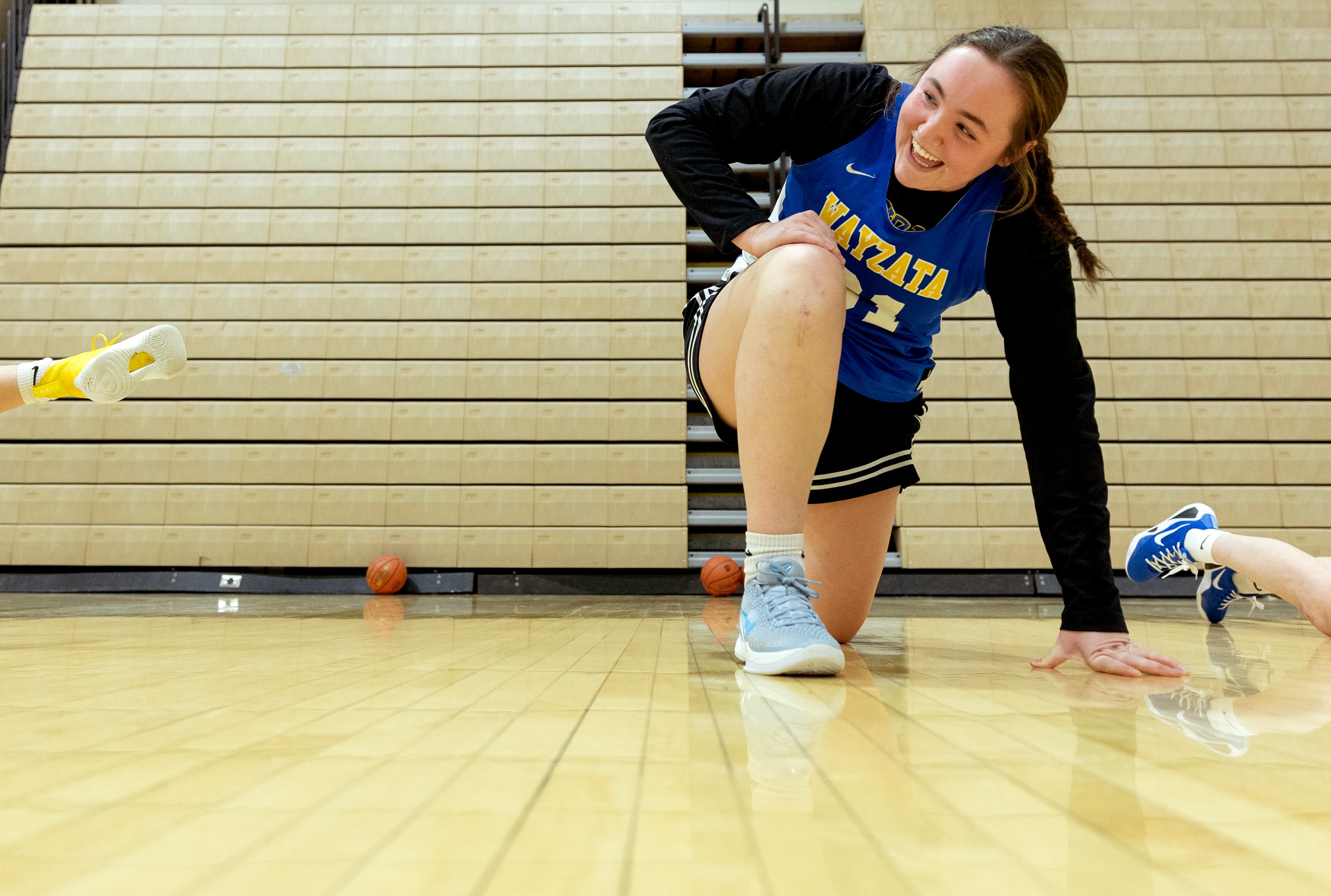
Kate Amelotte is the leading scorer on one of the state’s best basketball teams. But last year, during her junior season with the Wayzata Trojans, the guard scored zero points.
She was on no preseason watch lists, made no All-State team and was not her conference MVP.
That’s not because Amelotte discovered some hidden hooping superpower ahead of her senior season. Instead, she was sidelined for more than a year because of a torn anterior cruciate ligament (ACL).
Early in the Trojans’ 2024 soccer season, she tore the ligament in her right knee. That was followed by two surgeries and her relearning how to walk, run and jump. Amelotte recalled being “so nervous” to return to the court this past October.
“Now it feels really good,” she said, “[but] it was super nerve-racking, just because you worry it can possibly happen again.”
This week, some of Minnesota’s girls basketball players will mirror Amelotte’s junior year, sitting courtside wearing bulky leg braces as their teams compete for section championships. Others might have heard the tell-tale, dreaded “pop” of a teammate’s knee, or an opponent’s.
“It happened a lot around me,” said Amelotte, who plays the two sports most commonly discussed as part of the “ACL issue” — girls basketball and soccer. “Unfortunately, yeah, it’s just super common.”
“Super common,” and becoming more common. The National ACL Injury Coalition’s review of injury data found that ACL injury rates increased 25.9% from 2007 to 2022 — more than 32% for girls and 14.5% for boys.
But some of Minnesota’s coaches and medical professionals are hopeful that the uptick in ACL tears and knee injuries can be slowed, and they are taking action with their teams. No one is claiming to have a cure-all, but crucial to their hopes are proper resources and training. And perhaps above all: more awareness.
The Minnesota State High School League provides online materials for a free ACL injury prevention course but does not mandate that coaches complete it alongside a set of four required health and safety-related courses, such as concussion protocols.
That makes it unclear just how fast, and how far, best practices are reaching the state’s young female athletes.
Related Coverage


“I would say there’s one end of the spectrum where people have this as a consideration, a priority, and other people, it’s: ‘It’s just a byproduct. Sometimes kids get hurt,’” said Matt Solberg, the Proctor girls basketball coach and current president of the Minnesota Girls Basketball Coaches Association.
Solberg said he could see prevention training becoming more standardized or at least becoming a more highly encouraged resource for coaches.
“You’re never going to have 100% compliance and buy-in,” Solberg said. But “providing the opportunity for any type of resource training is going to be a step in the right direction.”
Minnesotan girls missing playing time because of knee injuries — especially ACL tears — isn’t a new dilemma. Former Fridley coach and MGBCA president Pat Barrett recalls bringing an orthopedic surgeon into the organization’s coaches clinic in 2000 to talk about an injury that affects teenage girls at a disproportionate rate.
In a state like Minnesota, where girls participate in high school sports at a rate higher than any other state, the injury is “almost like a public health problem,” said Jill Monson, the lead physical therapist at Twin Cities Orthopedics’ complex knee injury clinic.
“I’m seeing players on my daughter’s club soccer team tearing their ACL, and they’re 14 and 15 years old,“ said Gophers soccer head coach Erin Chastain, who, like Amelotte, played soccer at Wayzata. “I can’t remember anything like that, growing up.”
Monson said the increasing frequency of injuries might, in part, be a math problem. Young athletes are “having higher exposure to higher intensity sport than what you used to see,” she said.
Longer practices, more games and more tournaments — often year-round — lead to more opportunities for a wrong step or awkward jump. Then rest and recovery, or a lack thereof, factors in.
Playing a national schedule is “a lot harder than recovering from going down five minutes to your local park,” Chastain said. “It’s just a different level of wear and tear on your body and on your mind.”
Female athletes are more susceptible to ACL injuries than male athletes, at anywhere from 3.5 times more likely in basketball to 2.8 times more likely in soccer, according to the National Library of Medicine.
The typical time frame to return from ACL surgery is at least nine months, though an additional surgery to clear scar tissue extended Amelotte’s recovery. Amelotte’s future Creighton teammate, former Benilde-St. Margaret’s standout Kendall McGee, spent 20 months returning from a knee injury that included, among other tears and fractures, a torn ACL.
McGee’s combination of knee injuries was so severe that she had to attend school online for a month — the kind of thing that led Monson to call these injuries not just a physical risk, but also a “social disrupter” for student-athletes.
“[Sports] just becomes a big part of your life, and then it’s kind of just taken away so quickly,” Amelotte said. “I know I felt a little broken.”
Pursuit of prevention
Solberg remembers a season, five years ago, when two Rails players went down with season-ending knee injuries for the Class 2A team on the west side of Duluth.
“We can’t keep doing what we’ve been doing,” Solberg decided.
As the Rails experienced firsthand, ACL injuries are particularly common in sports that involve cutting, pivoting and landing, which puts stress on the ligament connecting bones in the thigh and shin through the knee joint.
No single risk factor or body movement leads directly to ACL tears, Monson said. Why female athletes are more susceptible is still the subject of much ongoing research and questions that need answers — how the angle of female athletes’ hips could impact the tilt of their knees; how hormonal changes during the menstrual cycle could impact the looseness of athletes’ muscles; whether sports equipment and training plans historically designed for male athletes fit what female athletes need.
Careful and consistent attention to research and addressing such factors “comes when people are aware of the burden of the injury,” Monson said, “but also the really bright, shining silver lining that prevention programs can be very effective.”
Across Minnesota, how student-athletes are accessing these prevention methods differs — some external partnerships, some in-house support, some proactive coaches.
When Moorhead High activities director Dean Haugo makes his rounds at northern Minnesota’s growing athletic powerhouse, he’s pleased with the results of a certain “eyeball test.”
“My data is probably a little bit limited,” he said. But: “We have a lot less kids with the full knee brace,” especially girls.
For the past four years, Moorhead has partnered with the local Sanford Health and Sports Medicine location in Fargo, bringing in an “athletic development coach” who works with the Spuds on repeated movement patterns specific to each sport.
“We had a good year last year, both a successful year on the court, on the field, but also part of it was we had an incredible year of kids staying healthy,” Haugo said. “Everybody’s got their philosophies on how an athlete should be trained. I think, any [coach] on the fence, after they looked at last year … that was eye-opening.”
New opportunities furthered the partnership.
Ben Noonan, an orthopedic surgeon and director of orthopedic research with Sanford’s Fargo location, is part of the Sanford ACL Initiative. Last summer, their lab screened almost 800 student-athletes from five area high schools.
Noonan and his fellow researchers test for quad, hip and hamstring strength and flag “known risky movements” (like the inward tilt of their knees) that athletes might exhibit while jumping and landing. These athletes are referred to Sanford’s free knee injury prevention program as a starting point.
If athletes opt into data collection, Noonan and his team follow up the next year to see whether they dealt with any injuries. Predicting healthy athletes who are at-risk is “really hard to do,” Noonan admitted. Currently, he said, there’s more predictability in identifying reinjury risk for athletes with previous ACL tears.
On the other side of the state, Proctor has attempted to address the same challenge.
If the girls basketball team is bumped from the district’s “nice wood floor gym,” Solberg adapts cutting drills to match the grip of the surface on which they’re practicing. Four years ago, the Rails began employing a strength trainer, who leads Solberg’s girls basketball team in weightlifting twice a week.
“Not every school has that resource,” Solberg said. “We didn’t have this resource in the past. Before that, you had to do it on your own.”
With Fridley’s girls basketball team, Barrett emphasized stride stops instead of jump stops, coached players into lower defensive positions and targeted quad strength. He had the benefit of experience as a physical education teacher and a strength training background when figuring out what might work best for the Tigers.
Like Sanford Health, Twin Cities Orthopedic has integrated with local high schools and colleges via athletic trainers and physical therapists. These professionals might work with coaches to implement dynamic, knee-targeted warmups beyond a simple light jog and stretching, Monson said. “Why not take that warm up and milk more value out of it by having it be a little more purposeful?”
If resources don’t trickle down to athletes through athletic programs or coaches, Monson tries to provide take-home resources to the recovering athletes she works with — exercises focusing on agility, direction change and hip and core stability.
“Even if your coach doesn’t buy into this,” she tells athletes, “you go in 15 minutes early and go through this on your own, and offer for a couple of your friends to do it with you.”
Both Monson and Noonan independently mentioned FIFA’s 11+ program, a 20-minute dynamic warmup program designed to reduce injuries, including to the knee. Research published in the British Medical Journal concluded twice a week implementation has led to a reduction in “severe injuries, overuse injuries, and injuries overall” in Norway’s young female soccer players.
“[Prevention and recovery programs] are like brushing your teeth,” Monson said. “We’ll have patients say, ‘When can I stop doing these things?’ Like, do you ever ask your dentist when you can stop brushing your teeth?”
Addressing the inevitable
Prevention is not perfection, however.
All coaches and medical professionals interviewed acknowledged that athletes dutifully following preventive programs might still suffer ACL tears. There’s an element of luck — or rather, misfortune. College athletes at the nation’s most well-resourced programs tear their ACLs, as do professionals.
“It’s not a one-size-fits-all,” Solberg said. “Even kids with pitch-perfect form are still having [knee injuries].”
Chastain also pointed out that today’s elite-level high school athletes are often bouncing between their school teams, club teams, and personal or small group training. A coach might not truly know how intense their athletes’ outside training might be.
“In an ideal world, all those people are talking and creating a comprehensive training plan for an athlete to follow,” Chastain said. “But because that’s unrealistic, I think the athletes and their families have to be the ones that understand [advocating for rest and recovery].”
Minnesota’s high school athletes who suffer knee injuries are not alone in their journeys back. Via word of mouth from coaches and teammates, players swap names of physical therapists and surgeons, like recommendations for the latest basketball sneakers or soccer cleats.
“I realized that it’s a process that you don’t really understand the struggle of until you’ve gone through it,” Amelotte said.
Some local physical therapy clinics offer “return-to-sport” training groups for athletes to recover together. Other athletes returning from knee injuries find companionship in teammates. Hopkins junior guard Ava Cupito missed her sophomore season with a non-ACL knee injury but was joined by then-senior Tatum Woodson, now at Belmont, out with an ACL tear.
“[Woodson and I] were always on the sideline doing PT,” Cupito said. “We would laugh, sometimes, like, our knees would be super swollen … it’s definitely good to have somebody who was doing the same thing I was doing every day at practice.”
Keeping players included in their team environments, supporting them in hobbies outside of sports and providing places for them to express their complicated emotions might not mend their ACL but could pave a smoother path back into the game.
The effects of knee injuries linger, even after returning to the court or field. For some, it’s a knee brace or leg sleeve. For others like Cupito, it was icing her knee after practices. For Amelotte, the biggest difference, after the nerves subsided, was a new perspective.
“I don’t really take it for granted anymore,” Amelotte said. “I didn’t really realize how much I really, really loved basketball until going through this injury and coming back.”
The hope is that, in the long run, fewer girls’ journeys require that comeback.
About the Author
Cassidy Hettesheimer
Women's sports reporter
Cassidy Hettesheimer is the Star Tribune's women's sports reporter, covering the Lynx, Frost, colleges and more.
See More
Comments