Where does Minnesota’s boys hockey state tourney rank among the nation’s biggest high school sports events?
Strib VarsityStrib Varsity’s Joe Christensen searched for answers to this question: What other high school state championships rival Minnesota’s boys hockey tourney?

The Minnesota Star Tribune
Big crowds, little charms and boundless passion. When it comes to the nation’s best high school tournaments, all have those distinctions in common.
The Minnesota State High School League’s girls hockey tournament begins Feb. 19, followed by wrestling (Feb. 25) and then boys hockey (March 4). Before the madness starts, all across the country, this is a good time for some observations.
The Minnesota boys state hockey tournament long has been viewed as one of the nation’s best high school spectacles, up there with Indiana boys basketball and Texas football.
In some states, high school tournaments attract more fans than college and pro games.
This winter, Strib Varsity searched to find which other state tournaments rival our boys hockey tournament. We searched by attendance, so in addition to the tournaments mentioned above, we studied girls basketball, girls volleyball and boys wrestling.
Here’s what we learned:
Minnesota boys hockey
The late Howard Cosell came to the St. Paul Civic Center in 1979, working for ABC, and raved about the tournament. Other guests in that era included Tom Hanks and Cheryl Tiegs.
In 2014, longtime NHL and Major League Baseball announcer Gary Thorne was invited to do the play-by-play.
“I think they thought it was kind of a lark,” Thorne told Strib Varsity this winter. “I don’t think they expected me to say yes, to tell you the truth.”
With Thorne calling the action, an announced crowd of 20,346 watched Edina defeat Lakeville North for the Class 2A state championship at Xcel Energy Center.
“I knew, obviously, the importance of the tournament to the state,” Thorne said. “But I didn’t expect just how big it was. I didn’t understand how deeply it was engrained in Minnesota tradition.”
Related Coverage
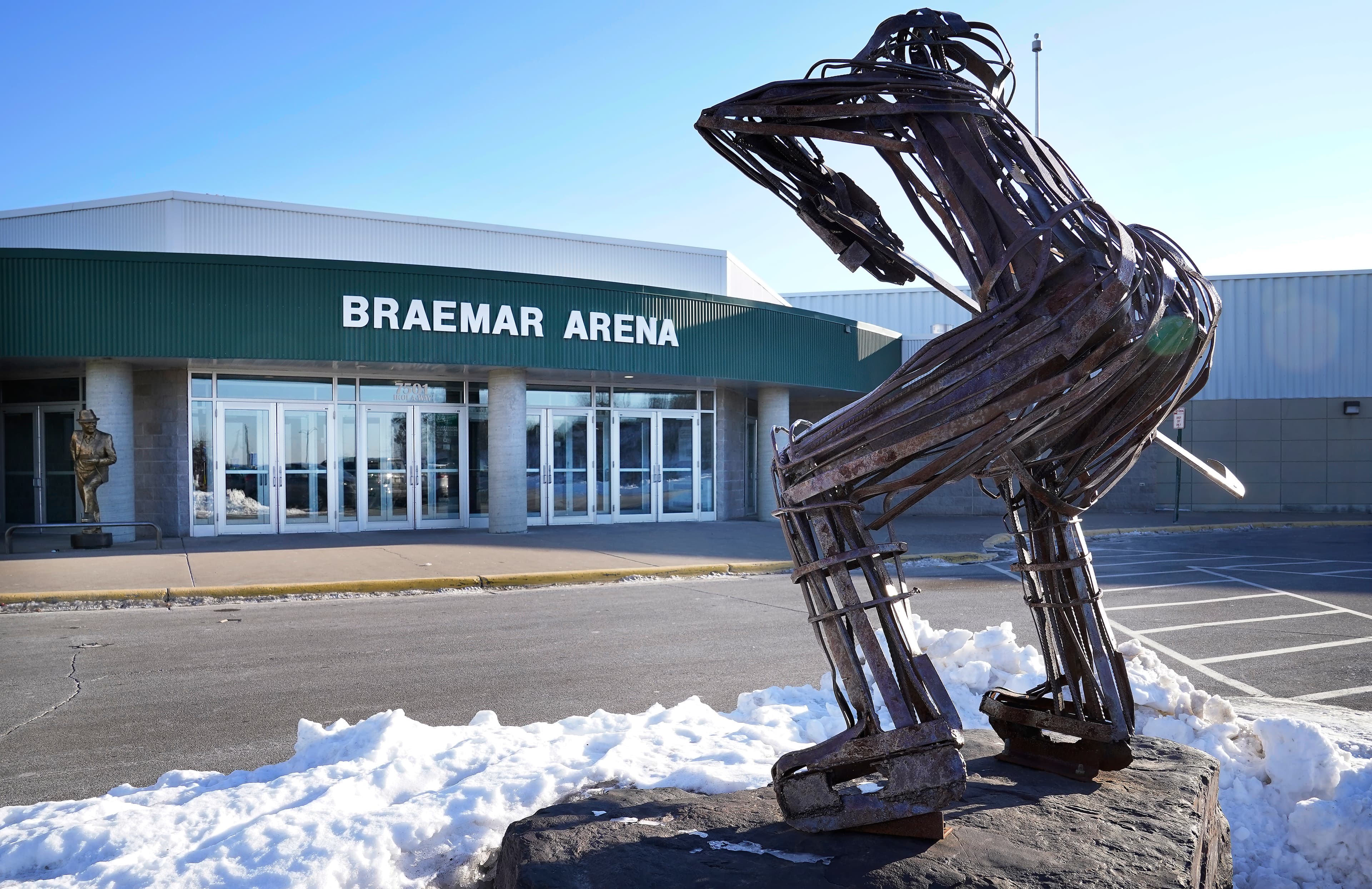
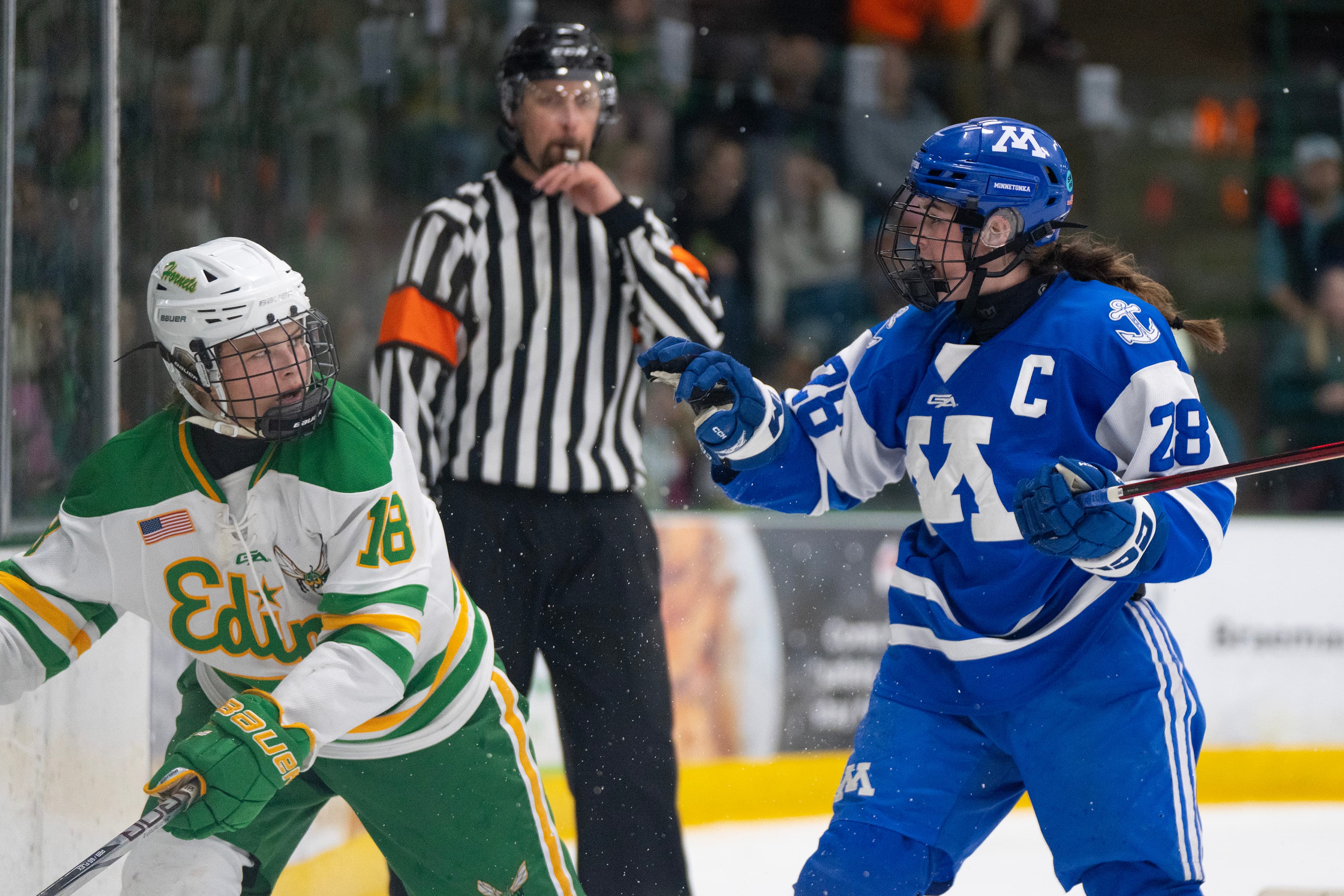

Minnesota’s tourney came of age at the St. Paul Auditorium before moving to the St. Paul Civic Center and what is now known as Grand Casino Arena. It was a one-class tournament from 1945 to 1991 and has had two classes since 1992.
Last year’s attendance was 127,598, including a tournament-record 20,491 for the Class 2A championship game between Moorhead and Stillwater.
Massachusetts and Michigan deserve mentions for their boys hockey state tournaments. Massachusetts showcases its state championship games at Boston’s TD Garden, the home arena of the Bruins and Celtics, with plenty of good seats available.
Michigan holds its boys hockey tournament at USA Hockey Arena in Plymouth, Mich., capacity 3,500.
Meanwhile, in Minnesota, it’s tough to get a seat at the tournament, with a 12-year waiting list for tickets.
Mike Crowley, a star in Bloomington Jefferson’s championship three-peat from 1992 to 1994, said his best memories go back even further, watching the Jaguars win the 1989 state tourney.
“I think we were all in pee wees,” Crowley said. “It’s watching with all your buddies. It’s getting out of school early, going to the pep fest. It’s the excitement people have, all the games on TV.
“And back then, it was the Civic Center with the clear boards. That was always kind of nostalgic, to be able to play in that rink.”
The competition for best tourney
Indiana boys basketball
It’s been almost 30 years since the Indiana boys basketball state tournament switched from one to four classes. The year was 1998.
“An entire generation of folks don’t remember it as anything other than a multi-class tourney,” said Greg Guffey, who wrote “The Golden Age of Indiana High School Basketball,” for the period between 1945 and 1959.
“Every small town, every big city, every township all had a school and a team back then,” Guffey said. “Community pride was at an all-time high.”
In 1954, tiny Milan, Ind., made it all the way to Hinkle Fieldhouse in Indianapolis and knocked off Muncie Central for the state title. That team inspired the 1986 movie “Hoosiers.”
It also inspired Guffey’s book “The Greatest Basketball Story Ever Told: The Milan Miracle.”
“In the movie, the team all of a sudden had success,” Guffey said. “In real life, the Milan team went to the final four in 1953, so they weren’t an unknown.
“In the movie, the coach is an old, kind of grizzled guy that’s getting a final shot at coaching. In reality, the coach was in his mid-20s and just starting out on his career.”
Minnesota had its own version of the Milan Miracle, when Edgerton, Minn. (pop. 900) won the 1960 state championship at Williams Arena.
This country has numerous boys basketball hotbeds — California, North Carolina, Chicago, Philadelphia and New York City, to name just five. Indiana’s remains special, even if it has changed.
“When you’ve had a moment like [Milan’s], it’s tough to change anything,” Guffey said. “And time passed without a good sequel.”
When Damon Bailey reached Indiana’s state championship game in 1990, a crowd of 41,000 turned out to watch at the Hoosier Dome.
Now the event is held at Gainbridge Fieldhouse in Indianapolis. The Saturday championship games are played in two sessions. Last March, the two small-school classes drew 10,457 for the first session, and the larger schools drew 14,483 for the night session.
“Today’s tournament is just as popular as ever among the schools competing,” Guffey said. “But the common fan is no longer there because it’s too hard to follow four separate tournaments.”
Texas football
There’s something fitting about the enormity of the Texas football state tournament. Everything’s bigger in Texas, including this beloved spectacle.
All across the state, tension builds for six weeks of playoffs, culminating at AT&T Stadium in Arlington, home field of the Dallas Cowboys.
“Whether you’re in the Panhandle or you’re down in Houston or Dallas or San Antonio or wherever, there’s always a lot of interest in these teams,” said Jon Poorman, who covers high schools for the Houston Chronicle.
The finals run from Wednesday through Saturday the week before Christmas, with 24 teams in 12 championship games. Texas has six classes for football, and each class is split into Division I and Division II.
This past season, those 12 championship games drew 184,272 fans, including 39,464 for the 6A Division I title game. Another 2 million viewers streamed the games.
“Texas high school football is a special thing,” Poorman said. “And it definitely brings the whole state together for that week.”
Texas’ single-game attendance record is 54,347 for the Class 5A Division I championship game between Allen, led by current NFL quarterback Kyler Murray, and Pearland in 2013.
Texas moved the finals to NRG Stadium in Houston for one year, in 2015, but attendance for the four-day event was 156,143, at a time when it was regularly bringing 200,000 fans to Arlington, so now it’s back.
What’s the draw? Part of it is talent. Consider this list of greatest Texas high school football players of all time — just at running back: Earl Campbell, Eric Dickerson, Adrian Peterson, Billy Sims, LaDainian Tomlinson and Doak Walker.
Honorable mention: Florida and Georgia. Like Texas, those states produce tons of Division I players, but their state tournaments aren’t quite as grand.
California girls basketball
Harold Abend has been covering California high school girls basketball for 44 years. When he started in 1982, the state tournament headliner was Cheryl Miller, who had just scored 105 points in a single game.
Her Riverside Poly squad won four consecutive California Interscholastic Federation (CIF) Southern Section championships.
“The bottom line is, the toughest playoff division in the United States [for girls basketball], really, is the CIF Southern Section open division,” Abend said.
As Abend said this, the No. 1-ranked team in the country — by Max Preps, Yahoo Sports and On3 — was Ontario (Calif.) Christian, which is led by the No. 1-ranked recruit in the nation, Kaleena Smith.
Now an associate editor for Cal-Hi Sports, Abend has seen his share of phenoms.
• Lisa Leslie: The three-time WNBA most valuable player led Inglewood Morningside High School to multiple state titles. In one game, she scored 101 points by halftime.
• Diana Taurasi: She won three NCAA titles at Connecticut and six Olympic gold medals. She was Naismith Prep Player of the Year but couldn’t win a state championship for Chino’s Don Lugo High School.
• Sabrina Ionescu: This future Hall of Famer lifted Orinda Miramonte to the state championship game as a senior, only to fall to Chaminade.
• JuJu Watkins: Before she became a household name at USC, she dominated the high school ranks at Windward School in Los Angeles and Sierra Canyon in Chatsworth.
• Kelsey Plum: The four-time WNBA All-Star led La Jolla Country Day School to four section titles and a CIF Division IV state championship.
In the CIF, once a team makes it through sectional play, it’s on to the state tournament at Golden 1 Center, home of the Sacramento Kings.
Abend said the Open Division games and Division I games are well attended.
“But a lot of the smaller division games are not as well attended,” he said. “And part of the reason here is, it’s a big state, and some teams have to travel so far.”
Looking around the country, other girls basketball hotbeds include Florida, New York, Illinois and Texas, to name a few. Minnesota has churned out talent, too, with the likes of Tayler Hill, Paige Bueckers and now Maddyn Greenway.
Nebraska volleyball
This is the state where 92,003 people packed Memorial Stadium for a Nebraska women’s volleyball game against Omaha. The Huskers have sold out 350 consecutive volleyball games at 8,300-seat Bob Devaney Sports Center in Lincoln.
So it makes sense that Nebraska would have regular sellouts for the high school state volleyball tournament, with four classes playing out the finals at Devaney. It’s broadcast on TV and streamed on Nebraska Public Media.
The four-day tournament drew 42,128 in November, a Nebraska record. The championship finals alone drew 8,653.
Reagan Hickey, a setter for Concordia-St. Paul, played in four Nebraska state tournaments with Papillion-La Vista.
“I might be a little biased, but I think it’s one of the most competitive state tournaments in the country,” Hickey said. “Just thinking back, my team could compete against some of the nation’s best, and we sometimes didn’t even make it past the first round.”
At Papillion-La Vista, Hickey played alongside one teammate who now competes for Oregon and one who plays for Arizona State.
Florida, California, Texas and yes, Minnesota, are among the other states churning out Division I talent. But Nebraska gets the nod for the best state tournament because of the atmosphere at Devaney.
Hickey said the first time she played there, “I might have blacked out. It was a surreal feeling.”
Iowa boys wrestling
Iowa isn’t the nation’s only home for rabid wrestling fans.
New Jersey’s state high school wrestling meet drew 41,971 over a three-day span in 2019. Pennsylvania drew a crowd of 8,221 for its wrestling finals. And in Minnesota, the three-day state meet drew 58,283 fans.
Iowa’s wrestling tourney popularity is going through a slight blip, as the four-day attendance last February was 57,939, including 11,908 for the Saturday finals.
“We are actually adjusting the schedule this year in an effort to reignite some interest and tighten the participation/travel time for our student-athletes and schools,” a spokesperson for the Iowa High School Athletic Association said.
Factoring in history, it’s tough picking any state wrestling meet over Iowa’s. Until recently, the Iowa finals sold out for 30-plus consecutive years, even after the event moved to the 15,000-seat Wells Fargo Arena in Des Moines.
“It’s electric,” said Kaiden Dietzenbach, a Minnesota State Mankato wrestler who won an Iowa state title at 138 pounds last year for Burlington Notre Dame. “There’s not many places where you can get that many people shoved into an arena and everyone’s watching you.”
The wrestling fandom extends to the college ranks, where Iowa and Iowa State both have been ranked in the nation’s top five this season.
Dietzenbach said he started watching Iowa’s wrestling finals at age 4. Between then and when he won his state title, he said, “I don’t think I ever missed watching the finals of the Iowa state tournament.”
About the Author
Joe Christensen
Strib Varsity Enterprise Reporter
Joe Christensen is our Strib Varsity Enterprise Reporter and moved into this position after several years as an editor. Joe graduated from the University of Minnesota and spent 15 years covering Major League Baseball, including stops at the Riverside Press-Enterprise and Baltimore Sun. He joined the Minnesota Star Tribune in 2005.
See More
Comments