Is Minneapolis vs. St. Paul the newest Twin Cities hockey rivalry?
Strib VarsityHockey Across Minnesota: The largest two cities in the “State of Hockey” are down to just one team each. Bragging rights and a rivalry could be on the horizon.
By Olivia Hicks
The Minnesota Star Tribune
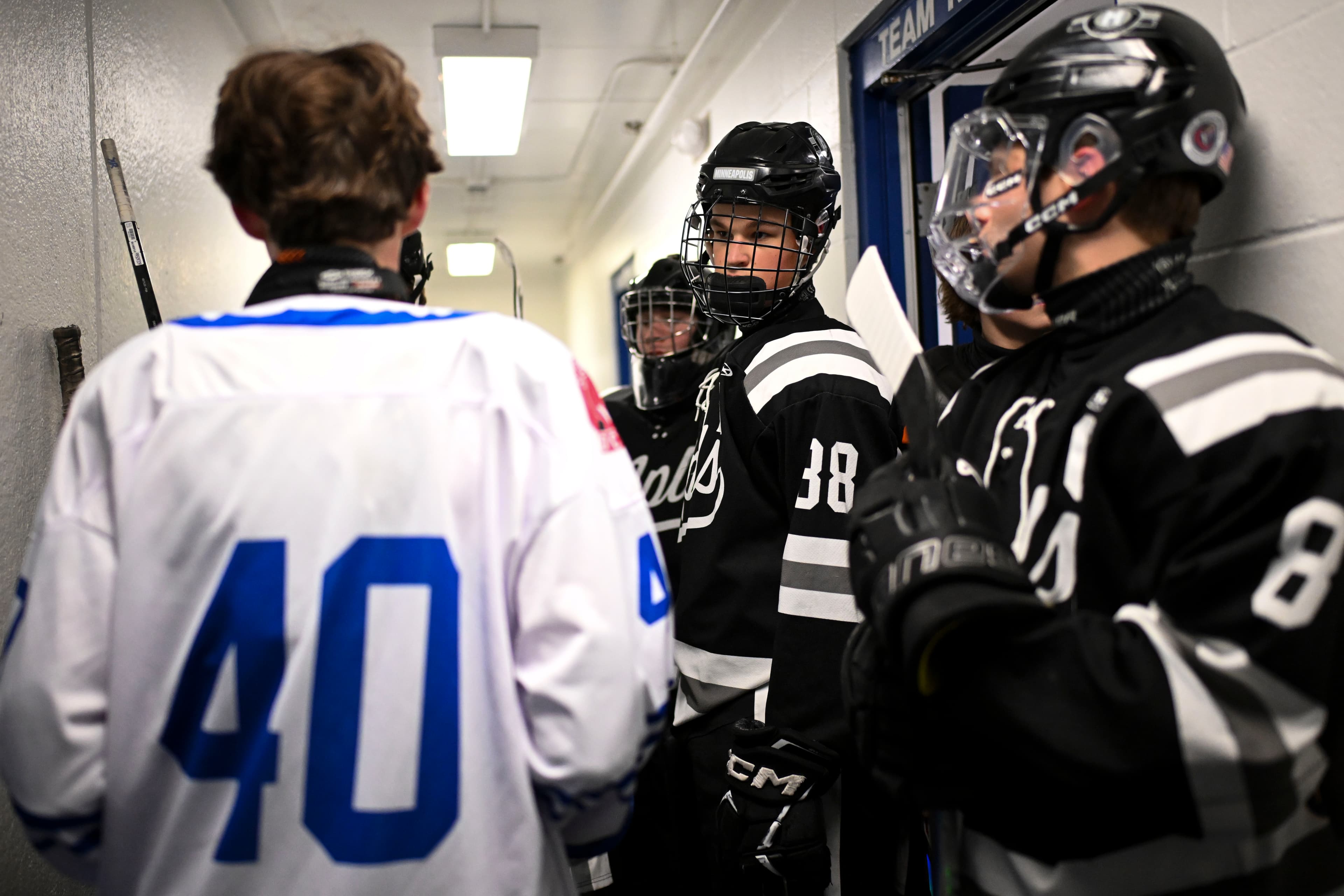
A string of seven high school emblems lined the hem of the Minneapolis Hockey team’s jerseys. Across the ice at the Charles M. Schulz-Highland Arena, St. Paul Johnson and Highland Park High crests stamped either shoulder of St. Paul Hockey’s white and blue “Capital City” sweaters.
When the newly formed St. Paul Hockey team faced off against its metro neighbor, Minneapolis Hockey, for the first time on Wednesday, Dec. 10, both teams carried history on their shoulders — literally.
“This is kind of a big game, boys. Minneapolis versus St. Paul,” Owen Christensen, a senior defender wearing Minneapolis’ black and white colors, spurred on his teammates in the visiting locker room.
It was the only time this hockey season either team will cross the river to play each other. To some, that meant the matchup was just a friendly game with low stakes: an easy 6-2 win for Minneapolis.
To others, it was the meeting of the last standing teams that represent the “State of Hockey’s” two largest cities. Bragging rights, but more importantly history, were on the line.
The fall of two hockey cities
Paul Ryan has a wide and warm toothy grin.
The St. Paul Hockey coach smiled as he shot down any rivalry talk. He strolled past his alma mater and former employer’s section of the rink, Cretin-Derham Hall, and into the corner Capital City now calls home.
“It’s not Minneapolis,” Ryan said of the team’s biggest rival. Instead, the feud is public vs. private.
As head coach, he led the team through a transition period over the past six months as the St. Paul school district combined all of its boys varsity hockey programs into just one team.
“When we got together in the summer, I said: ‘Johnson’s done. Highland, Central’s done. We’re St. Paul,’” Ryan recalled.
St. Paul Johnson ended its historic eastside hockey program in February after changing demographics and an exodus of players to private schools diminished a hockey empire. In its prime, the Johnson Governors won four state titles and visited the tournament 22 times.
Related Coverage
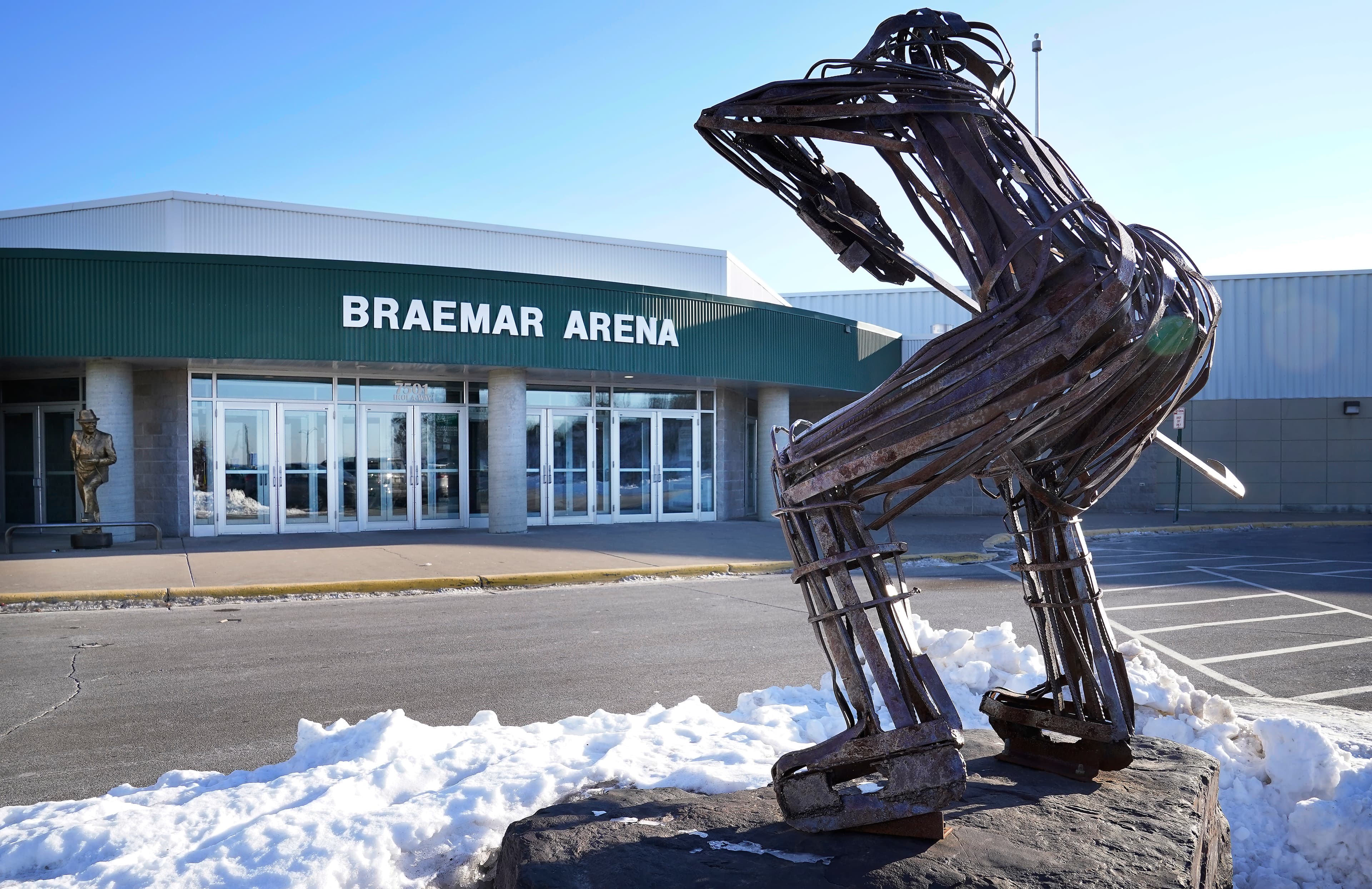
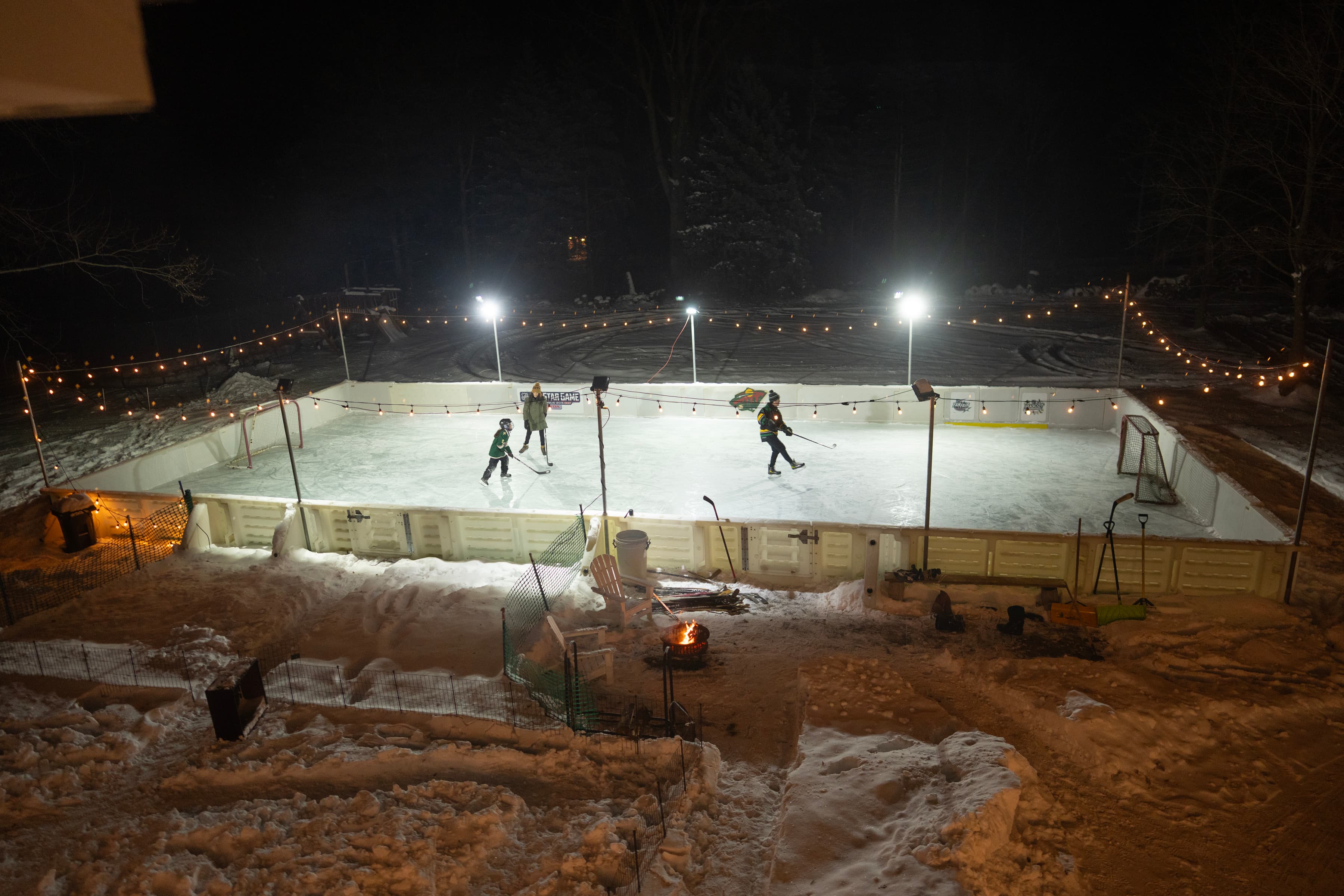
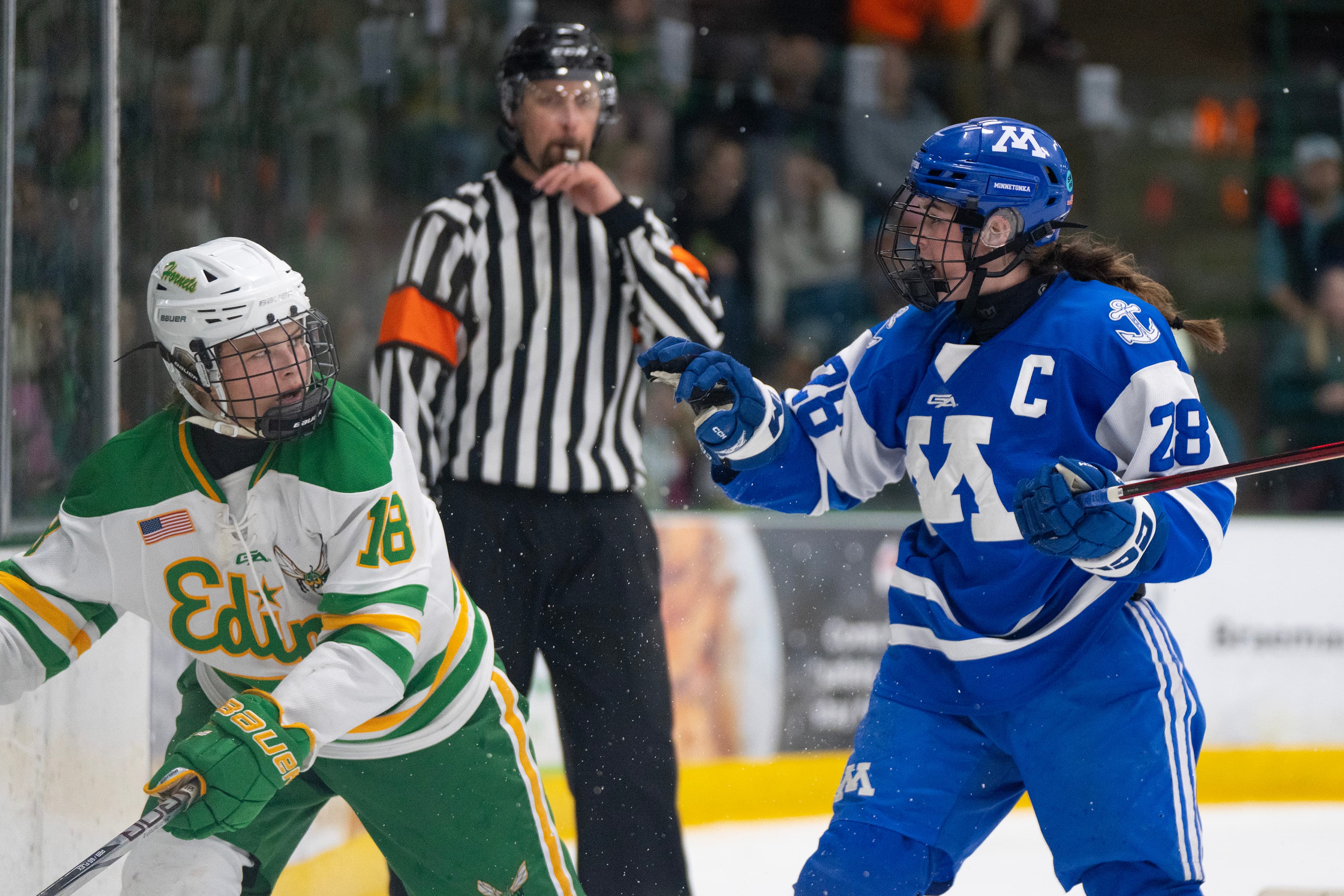
Johnson formed a co-op with Como Park during the 2015-16 season, and Como and St. Paul Central High School’s rosters combined in 2006. Highland Park briefly joined Como and Central’s co-op before reviving its hockey program in 2010 following a 23-year hiatus. The team then combined with Central for the 2016-17 season.
Now the teams have folded into one.
Ryan, the head coach of the Highland Park Scots for the last two years, only had to look across the river to see St. Paul’s future. As Minneapolis’ once-prolific producers of hockey talent merged into one team, “We knew what was coming for us,” he said.
More than a century ago, Minneapolis schools prided themselves on becoming some of the first in the state to play varsity hockey. Among Minneapolis’ homegrown high school talent, some went on to win gold in the Olympics, play against the Soviet Union in the 1980 “Miracle on Ice” game and lift the Stanley Cup.
Minneapolis schools fractured into east and west teams in 2005. Minneapolis has had one team representing seven public schools since the 2010-11 season.
Minneapolis’ 15-year advantage against St. Paul as one team was palpable on game night.
Loud, pulsating rap music seeped through the swinging locker room door housing the Minneapolis Hockey team. Inside, gear was strewn in a haphazard manner that said “home,” even on St. Paul territory. Like any 15-year-old, the team oozed confidence, even coming off of a three-game losing streak.
Despite St. Paul public schools’ rich hockey history, it’s Minneapolis that currently holds the better record this season at 5-4. St. Paul sits at 1-8, with its latest loss coming against Irondale on Dec. 20.
Johnson was the last St. Paul public school to visit the state tournament in 1995. But Minneapolis’ 2022 return to the tournament after 28 years offers Capital City a glimmer of hope.
Building a new hockey rivalry
Is there a hockey rivalry brewing between the Twin Cities? It depends on whom you ask.
Historically, St. Paul’s hockey rivalries were largely internal.
“In St. Paul, the biggest hockey rivalry was one of the two East Side schools: Harding and Johnson,” said John Vosejpka, the city’s resident hockey historian and head of St. Paul Sports, the St. Paul City Conference athletic website (https://saintpaulsports.org).
Minneapolis and St. Paul enjoyed occasional rivalries during the Twin Cities Conference, spanning from 1922 to 2006, Vosejpka said. The two met a handful of times in state quarterfinal and semifinal matchups but largely remained in their own corners of Minnesota’s hockey scene.
As some residents reminisce about the St. Paul and Minneapolis hockey legacies of yesterday, others are looking on the horizon — with mixed opinions.
For some, the reality of a rivalry depends on performance margins. For others, the hope of injecting renewed hockey energy in both cities outweighs points discrepancies.
“They’re in our conference, but they’ve been a sleeping old powerhouse,” said Marshall Claeson, a senior forward for Minneapolis Hockey. “They used to be pretty good, but now they aren’t. So, it’s not a rivalry as much anymore, but maybe they’ll be better now with these two teams.”
Junior teammate Emmit Anderson, a fellow forward, cut in minutes before faceoff: “I think we’re gonna start a rivalry. I feel like the last few years it’s been us, Orono and Delano. Now with the whole city together, I feel like it’s kind of cool. Two big cities.”
The two players’ new coach, Chris Grassel, relished in the idea: “100 percent, it is a rivalry. There is a lot that goes into this game.”
“I think it’s the start of something,” added Kyle Johnson, who is the father of St. Paul Hockey’s goalie, Max Johnson, and watched from the stands. “It’s the first Minneapolis vs St. Paul: starting something that could be, down the road, big.”
‘One city, one team’
There’s a blank space on the back of both teams’ jerseys where a player’s name should live. A number and a city name designate each player on the ice instead.
“We call it, ‘One City, One Team,’” Grassel said.
St. Paul’s motto is nearly identical: “One St. Paul, One Team.”
The two teams, like their cities, might like to think of themselves more like sisters than twins, but they have more in common than not. Both share the uniquely uncomfortable reality of wearing one jersey that represents multiple schools. Both have lost more players than either city’s once-dominant hockey culture can afford. And both teams have the opportunity to boost the Twin Cities’ hockey morale.
“People are coming out and buying our gear, and I think they really like the thought of St. Paul being similar to Minneapolis,” Ryan said. “I guarantee you, we want to win, and we want to have that, ‘Yeah, we beat Minneapolis.’ ”
As the players’ skates bit into the rubbery rinkside floor, St. Paul’s insistence that there was no rivalry melted off. The two teams awkwardly shuffled past each other in a narrow hallway ahead of faceoff, each sizing the other up.
Senior forward Ian Wallace spelled out exactly what was at stake when asked what he might say to throw the opposing Minneapolis players off their game: “I can’t say that in the Star Tribune!”
Even if it’s not a rivalry, it’s the start of something.
...
Hockey Across Minnesota
Minnesotans in the NHL: Brock Nelson will always be known as an Islander
Warroad native Brock Nelson was a first-round draft pick by the New York Islanders and played nearly 12 years on Long Island before he was traded in March to Colorado.
But the new chapter he has started with the Avalanche has the potential to be special.
Colorado is leading the NHL — and at an unprecedented pace.
Not only are the Avalanche only the second team in league history to go 26 games with just one regulation loss, but their 59 points through 35 games tied for the second most all time.
Nelson, who could have left Colorado in the summer as a free agent but instead chose to stick with the Avalanche on a three-year, $22.5 million deal, has fit in as the team’s second-line center and a distributor on the power play alongside Nathan MacKinnon and Cale Makar.
The 34-year-old can also reach 1,000 games this season.
“It’s been great,” Nelson said after he had a goal and two assists in Colorado’s 5-1 win over the Wild on Dec. 21 at Grand Casino Arena. “Obviously, it’s been different, but got a taste of it last year and just how awesome it was, and it just felt right, and I was happy to be back here.
“Now, it’s just awesome.”
— Sarah McLellan
World Junior history: Hughes, Kaprizov impressed U.S. coach Motzko
Bob Motzko, the Gophers men’s hockey coach, is pulling some double duty lately, serving as head coach for Team USA in the IIHF World Junior Championship, which will be played Dec. 26 through Jan. 5 at Grand Casino Arena in St. Paul and 3M Arena at Mariucci in Minneapolis. Motzko also couldn’t help but notice the big move the Wild made, trading for superstar defenseman Quinn Hughes.
“There’s no question there’s some buzz going on with that trade,” Motzko said from Team USA training camp in Duluth. “That was a pretty gutsy move by the Wild to make that for a win-now situation, and it’s getting a lot of raves around the hockey world. They had to give up some great talent for it, but he’s one of the greatest defensemen in the world, and to get your hands on a player like that, you’ve got to go for it.”
Motzko coached Team USA to a gold medal in the 2017 world juniors and a bronze medal in the 2018 tournament, and one of his players in 2018 was Hughes. The coach also is thrilled that Wild defenseman Brock Faber, a former Gophers captain and world juniors gold medalist, has Hughes as his defensive partner.
“You have two guys that can skate at a world-class level,” Motzko said.
On the way to the 2017 gold medal, Team USA faced Russia twice, with the American’s winning 3-2 in pool play and 4-3 in a shootout in the semifinals. Russia’s star that year: Kirill Kaprizov.
“Nobody back in Minnesota knew who he was back then,” Motzko said of Kaprizov, a 2015 fifth-round draft pick of the Wild. “It was just scary watching him on film and then going up against him.”
— Randy Johnson
Livestreams to watch
White Bear Lake, coming off a 3-2 loss to rival Hill-Murray, takes on Hermantown for a boys hockey game Dec. 27 at 7 p.m. The Proctor/Hermantown girls hockey team (8-3) plays Thief River Falls (11-3) on Dec. 30 at 3 p.m.
This week’s apple
Reader Stewart McMullan grew up playing Minnesota hockey in the 1970s and 1980s. His favorite topic to debate with his family was which arenas were too cold and too cramped.
“We laugh about playing at the old Saint Mary’s Point Ice Arena, which was in Stillwater and always seemed 20 degrees colder inside than it was outside and had locker rooms the size of a dorm room. The Ramsey County arenas (Biff Adams, what is now Charles M. Schulz, Pleasant) are legendary too: cold, small and they had chain-link fencing instead of glass above the boards,” he wrote.
. . .
Thank you for reading Hockey Across Minnesota (HAM). Email me at olivia.hicks@startribune.com with story tips or message me on X or Instagram. See you at the rink!
About the Author
Olivia Hicks
Strib Varsity Reporter
Olivia Hicks is a reporter for the Minnesota Star Tribune.
See More
Comments