Minnesota girls reinventing ‘hockey talk’ and using it for good
Strib VarsityHockey Across Minnesota: Edina’s girls team is chippy, chatty and changing what a hockey player sounds like. And as a bonus: It’s helping develop team chemistry.
By Olivia Hicks
The Minnesota Star Tribune
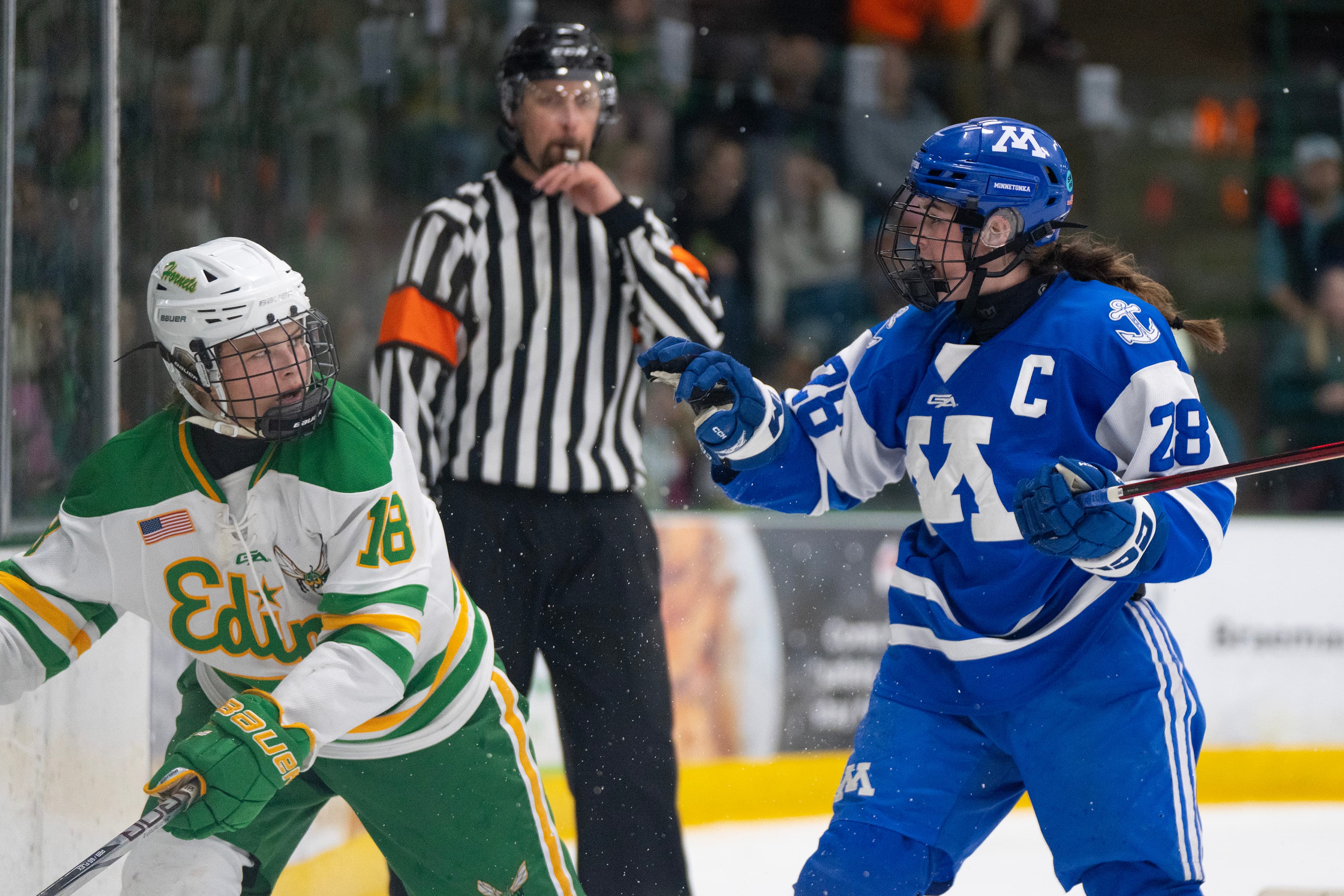
When Edina girls hockey captain Taylor Gardner brought the Hornets to a 4-4 overtime standoff against west metro rival Minnetonka on Saturday, she claimed the roster wasn’t full of slang-slinging trash-talkers.
“Girls just don’t chirp as much [as boys], it’s more just aggression,” the senior defender said, echoing a common stereotype about female athletes’ trash-talking.
But as her blades sliced through the ice at Pagel Activity Center, an occasional colorful word was hurled from one net to the other, often accompanying a tripping penalty or a thrown shoulder.
“Everyone just gets a little chippy,” Gardner conceded. “It definitely got a little bit gritty out there at moments, and a few words were exchanged.”
Hockey players are known for their vocabulary: a combination of homemade terms that loosely resemble their original meaning, like “biscuit” and “puck” sharing a shape, and abbreviated words that typically end in an “ie” or “er” sound, like “chippy,” “duster” or “bender.” Sometimes terms are simply nicknames for technical words, like using “bar down” as a shortcut to explain a puck popping off the crossbar and slotting straight down into the net.
More often than not, these phrases are used to insult and throw opponents off their game.
Male hockey players have historically used this vocabulary to develop an identity during the most vulnerable development years in locker rooms, said Andrew Bray, a former junior hockey player turned sociolinguist at the University of Rochester in New York who built his career studying the language.
Amid his research on hockey slang’s origins, he found a pattern: Well-liked and skilled players introduced new terms and others adopted them in an effort to establish a group identity, often excluding female players from membership.
Girls and women’s players, in response, are creating their own way to talk hockey.
While Edina players claimed boys hockey slang use is near-constant, they are taking a more nuanced approach, defined by occasional “chirping,” or trash-talking, and an emphasis on using the hockey dictionary to bond.
Bray found something similar in a survey of the Ohio State University women’s team. Female players knew all the same slang as the male players he interviewed but chose to use it to “talk about that part of our lives and no one else knows what it means.”
Related Coverage


“OSU players stressed that their use of the hockey vernacular was never in an attempt to put down or belittle other players, but to better their chemistry with teammates, and increase morale,” wrote Bray, who recently finished a visiting professorship at Carleton College in Northfield.
Edina’s Gardner echoed this sentiment and said that chirping takes place more often in practice as a way to create team intimacy through inside jokes. Other Minnesota teams have followed suit, like Holy Family goaltender Kayla Swartout inspiring the whole team to call the butterflies she feels during shootouts “dinosaurs” instead.
Hockey’s distinct vernacular and identity categorize it as a “lifestyle” sport, according to Bray. Like skateboarding or surfing, there are specific characteristics, both physical and linguistic, that tie athletes’ identities to the sport.
“There are hockey-specific clothing companies. There are hockey looks. People look like they play hockey,” Bray said.
He found that people sounded like they played hockey, too. But the hockey sound and, therefore, identity was overwhelmingly male.
Part of this comes down to numbers. During the 2024-25 season, 12,418 high school-aged girls were registered with USA Hockey, the nation’s governing body. In comparison, 66,729 boys were enrolled.
Bray found that American girls “were far less likely to encounter the hockey identity, and therefore the lexicon at its center,” than Canadian girls who played hockey in larger numbers and skated in coed leagues.
Even Edina players associate the vernacular and trash-talking with boys and men’s players but still choose to use it on their own terms.
Both the Minneapolis Hockey boys team and the University of Michigan men’s hockey team, in Bray’s research, didn’t think girls or women’s players used the same slang or trash talk.
“No, I think it’s a boy hockey thing,” said Marshall Claeson, a senior forward for Minneapolis Hockey. “I feel like their [chirps] are probably different.”
So, if the archetype of a hockey player sounds like a boyish, foul-mouthed trash-talker (chirper) and looks like a head of lengthy locks trimmed into a mullet (flow), where does that leave girls players?
Edina players are helping to change that image one game at a time by creating their own hockey sound, sometimes via a sprinkling of trash talk and more often than not with slang used among each other.
“Occasionally, we’ll be like ‘Oh, she’s so dusty,’ ” Gardner explained, visibly cringing and giggling as she said it. But most chirps that sound negative are used as encouragement, like calling a teammate’s goal “nasty.”
Gardner had a hard time recounting what was said in the heat of the moment as the Skippers crawled back to tie the game with two third-period goals, but the captain knew there was back-and-forth when the opposing team crowded the Hornets goaltender.
“[During a game], I think boys just do it for fun, just to make them feel bad about themselves,” Gardner said. “I think ours just comes down to, if you hurt one of our teammates, we’re not gonna put up with that.”
Bray doesn’t see a future where chirping isn’t a part of high school hockey, even though trash talk is against Minnesota State High School League rules.
“It’s not going to go away,” he said. “The refs can try and police it, but I don’t think it’s gonna stop.”
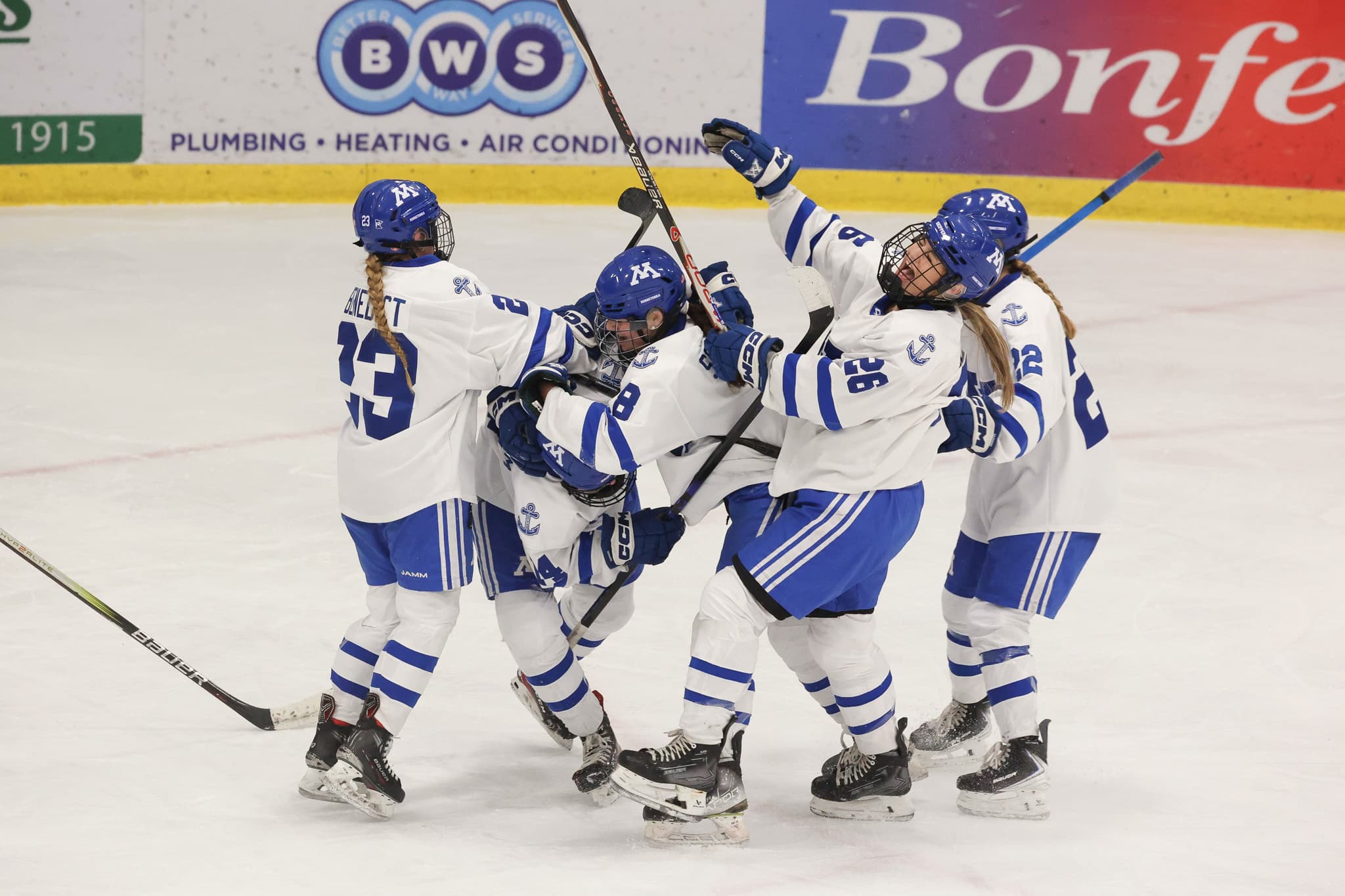
As the overtime minutes ran out, the aggression and chirps from earlier simmered off. After the customary postgame slapping of each other’s gloves, rival players clad in green and blue wrapped their arms around each other.
“The rivalry goes back a long time,” said Lucy Bertram, Edina’s goaltender. “Every level you’re at, you’re against these same girls. … We have a close relationship which makes the rapport even stronger.”
. . .
Hockey Across Minnesota
Minnesotans in the NHL: Jake Oettinger reminisces on days in Lakeville
Jake Oettinger plays for one of the best teams in the best league in the world and is having another standout season that will likely include him becoming an Olympian next year.
But if he could rewind time and go back to being a 14-year-old goaltender at Lakeville North, he would.
“In a second,” Oettinger said. “That’s some of my favorite memories, and those guys are still my best friends to this day. So, I’m happy [and] lucky that my journey started here.”
Before he was in net for the Dallas Stars, Oettinger was sprinting off the bus so that he and his buddy were the first to get on the ice at Greenridge Park in Lakeville.
Outside, Oettinger skated as a forward or defenseman — “I don’t think I’ve ever played goalie,” he said — but that didn’t stall his development in the rink.
Lakeville North was runner-up in 2014 after Oettinger led the school to the Class 2A championship game as a freshman. He went on to the USA Hockey National Team Development Program and Boston University before the Stars debuted him in the playoffs after drafting him in the first round in 2017.
Since then, Oettinger has ranked among the top at the position in the NHL, with his eight-year, $66 million contract making him a Dallas cornerstone.
Oettinger’s career has included multiple appearances with Team USA, and after being named to the roster for the 4 Nations Face-Off earlier this year, he’s projected to be back in the red, white and blue for the Olympics in Italy in February.
But Oettinger, 26, still relishes going home.
When the NHL schedule is released each year, he looks first at when the Stars will be in Minnesota to face off against the Wild.
“Whenever we play them, I feel like [it’s] super intense,” Oettinger said. “It feels like a playoff game. We see these guys a lot, played them in the playoffs, so it feels like playoff intensity. The crowd’s always incredible. Such a good fanbase.
“So, it’s always really fun.”
— Sarah McLellan
College spotlight
Is Minnesota Duluth men’s hockey heading toward a fourth NCAA title under coach Scott Sandelin? The Bulldogs are certainly in the mix.
UMD (14-6) is No. 5 in the latest USCHO.com poll after missing the NCAA tournament the three previous seasons. The Bulldogs have a high-powered first line with Max Plante (who leads the nation with 30 points), Zam Plante (25) and Jayson Schaugabay (21). The Plante brothers are Hermantown products, and Schaugabay hails from Warroad.
Like Sandelin’s best teams, UMD is very tough defensively. Adam Gajan, a sophomore goalie from Slovakia, has a 1.92 goals against average and .919 save percentage. Defenseman Adam Kleber is a 6-foot-6 force from Chaska who will likely make the U.S. roster for the World Junior tournament, along with Max Plante.
In late October, the Bulldogs swept the Gophers in Minneapolis by a combined score of 7-1. The head-scratcher of late is this: UMD is 10-0 in series openers but 1-5 on Saturdays in NCHC play. The Bulldogs will try to fix that when they return from winter break.
— Joe Christensen
Minnesota top 25s:
Girls: The latest chapter of the Edina vs. Minnetonka rivalry made it in the top 25 this week.
Boys: Moorhead remains on top while Stillwater and St. Thomas Academy enjoy a brief surge in the rankings this week.
This week’s apple
Steve Molin, a retired Lutheran pastor and former St. Cloud State goalie, gave me a comical crash course on the hockey rule book this week. Former White Bear Lake, Gophers and NHL player Bill Butters told him: “Steve, did you know that goalies are not really players? Look it up in the rulebook: ‘Each team shall consist of 18 players and two goalies.’ ”
. . .
Thank you for reading Hockey Across Minnesota (HAM). Email me at olivia.hicks@startribune.com with story tips or message me on X or Instagram. See you at the rink!
About the Author
Olivia Hicks
Strib Varsity Reporter
Olivia Hicks is a reporter for the Minnesota Star Tribune.
See More
Comments